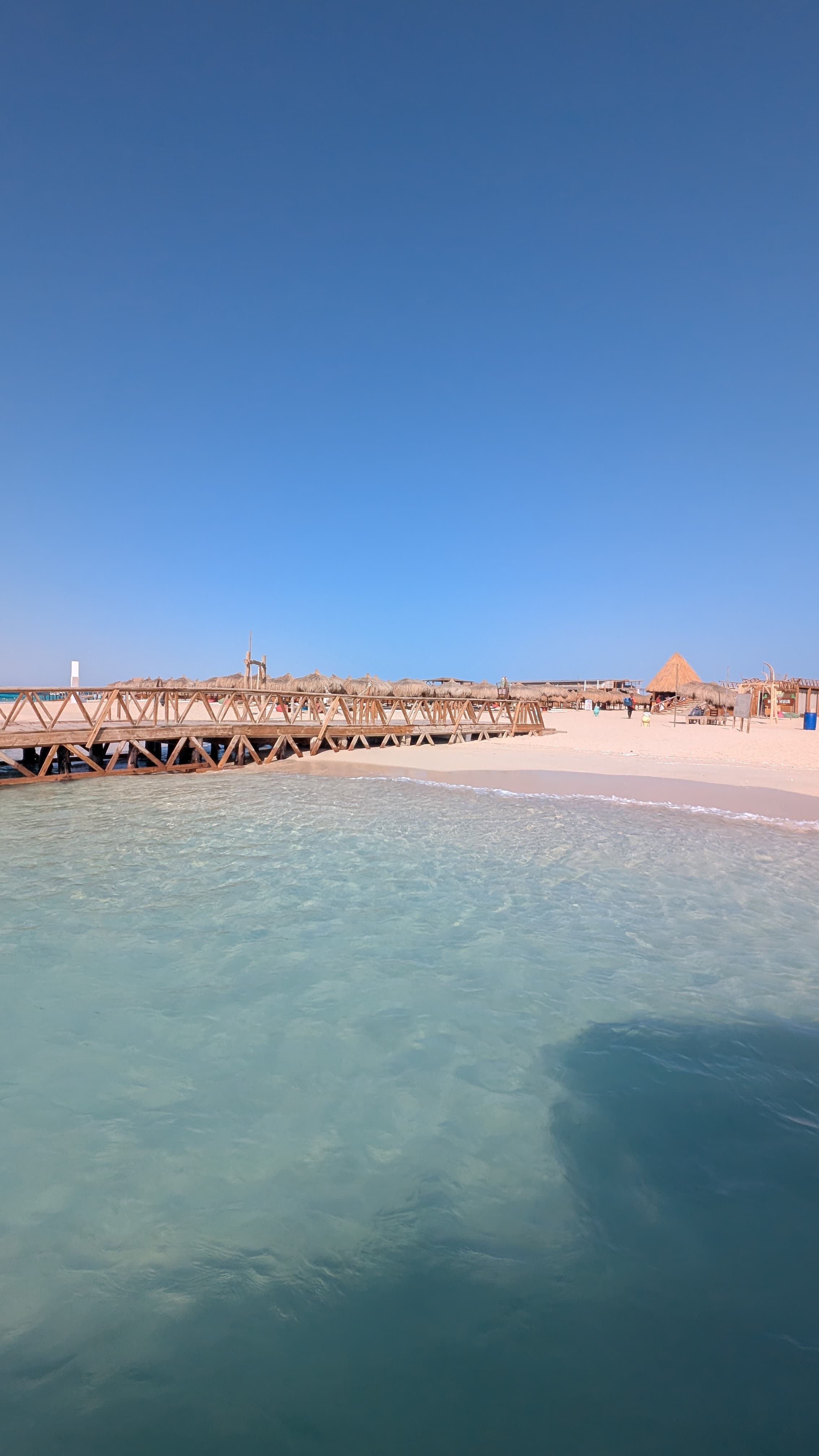
Hurghada Doesn't Pretend
A resort town, a reef, a speedboat, and a very necessary exhale
The bus from Luxor to Hurghada crosses the Eastern Desert — four hours of brown hills and dry wadis and almost nothing else. Then the Red Sea appears on the right, and then Hurghada begins: a long strip of hotels along the coast, billboards for dive operators and snorkelling trips, the infrastructure of a place that exists entirely to host people who want to be near the water.
I had been moving through Egypt for twelve days. Cairo's density and noise, Luxor's depths of history — the Valley of the Kings, Karnak, Luxor Temple. All of it extraordinary. All of it, by the time I arrived in Hurghada, slightly more than I could process. I needed to stop.
What Hurghada Actually Looks Like
Hurghada is not a pretty town in the way that you might hope. The seafront strip — the Corniche — has the faded glamour of a resort that expanded faster than it was planned: large hotels in various states of upkeep, souvenir shops, restaurants with English menus and laminated photos of the food. Away from the seafront there is a working Egyptian town, which is more interesting, but most visitors don't go there.
None of this is a complaint. Hurghada knows what it is and doesn't pretend otherwise. It was built for people who want beach and reef access, and it delivers those things reliably. I arrived without high expectations and left having spent three very useful days doing almost nothing.
The Reef Off the Beach
The useful thing about Hurghada is that the coral reef is not a day trip. It's right there. Some of the better hotels have reef directly off their private beaches; from the public beach at Magawish you can wade out fifty metres and be above living coral. I went in twice on the first afternoon without booking anything, without hiring a guide, without going anywhere.
The water is the Red Sea's particular shade of blue-green — the colour that looks digitally enhanced in photos and turns out to be exactly that colour in person. Visibility is extraordinary. The coral is not pristine — Hurghada's reefs have taken decades of tourist pressure — but there is still enough: brain coral, table coral, fish in dozens of species that you can't name but keep wanting to.
Snorkelling here after the temples of Luxor is a specific kind of reset. No columns, no hieroglyphs, no scale to reckon with. Just water and colour and fish that don't care about any of it.
Out on the Water
My last full day I hired a speedboat — a small fibreglass one, two other passengers, a driver who said very little and drove very fast. We left the marina at nine in the morning and went south along the coast, past the resort strip with its jetties and floating platforms, out to open water where the sea floor was thirty metres down and still perfectly visible.
This is the thing about the Red Sea that I keep trying to explain: the water is the colour of a swimming pool hit by direct equatorial sunlight and turned into something supernatural. In photos it looks edited. In person it's just what the water looks like, and you find yourself staring at it for longer than intended, trying to figure out how it's doing that. The answer, as far as I can tell, is geology and latitude and the absence of river sediment — the Red Sea is flanked on both sides by desert, so nothing washes into it.
We stopped at two points offshore. At the first I swam for an hour. At the second I floated on my back for twenty minutes and looked at the sky. The water is extremely salty — high salinity means you sit higher than usual, and floating requires almost no effort. You just stop fighting gravity and drift.
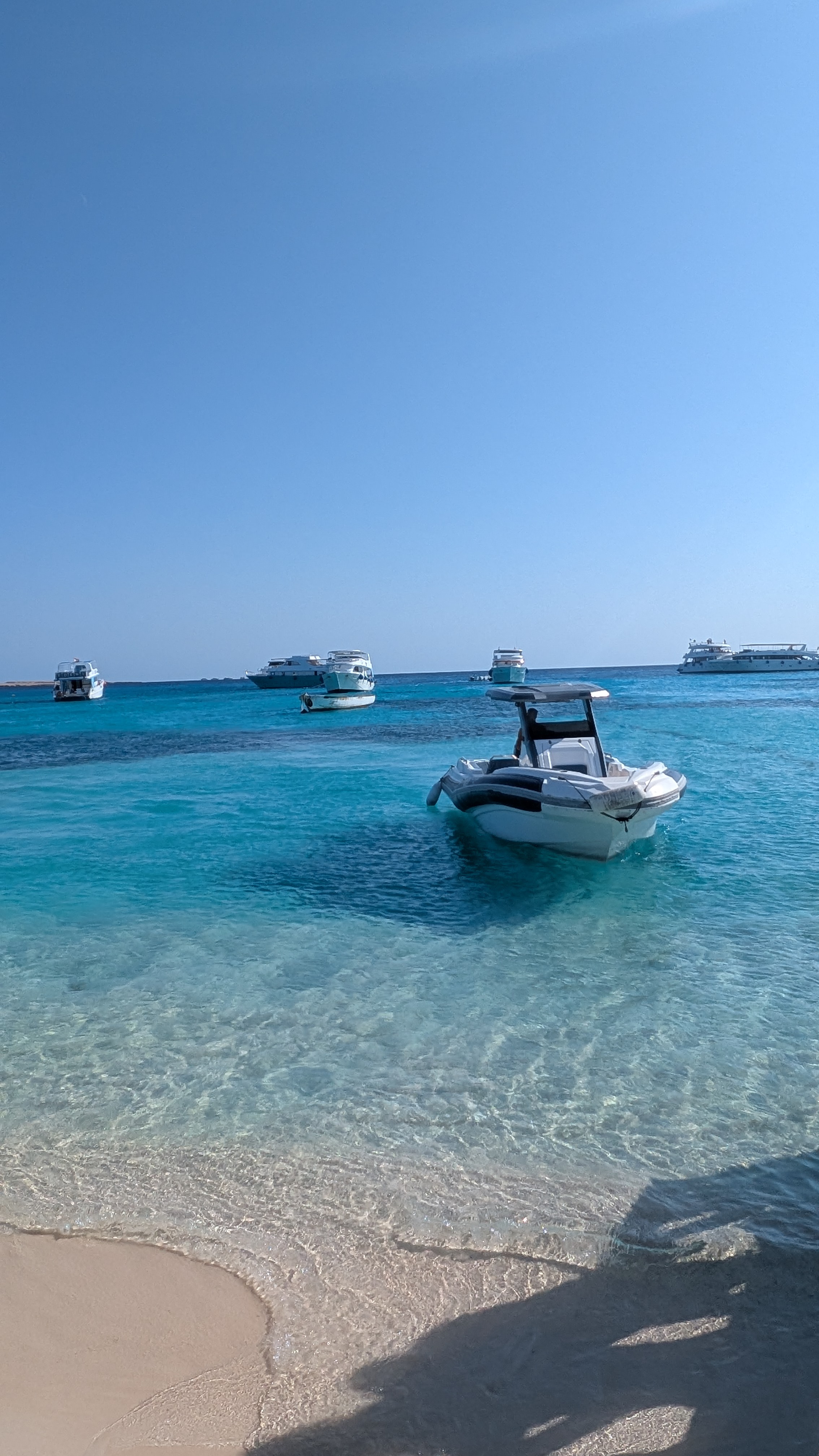
I was thinking about the pyramids, as it happens. About the fact that I'd spent two weeks moving through a country that operates on a different timescale than any place I'd been before. The pyramids are 4,500 years old. The Valley of the Kings is 3,000. Karnak was built and expanded across 2,000 years. And now I was floating in the Red Sea on my last day, and the water was this colour, and the sky was cloudless, and all of it seemed somehow connected — the scale of what the ancient Egyptians built and the scale of the landscape they built it in.
The Town at Night
The Corniche in the evenings is pleasant in a low-key way. Local families out walking, teenagers on motorbikes, a few dozen tourists doing the same circuit. I found a small restaurant two streets back from the waterfront, run by a family who seemed mildly baffled by my presence, and ate grilled fish and rice and bread for about four euros. This is also Egypt — the version that exists alongside the one in the travel writing, quieter and less dramatic and completely real.
Why It Works
There's a logic to ending a heavy Egyptian trip in Hurghada that I hadn't anticipated but that turned out to be correct. Two weeks of five-thousand-year-old monuments asks something of you — attention, interpretation, the sustained effort of trying to understand a civilisation that no longer exists. Hurghada asks nothing. The water is warm. The fish are indifferent. Then the driver starts the engine and you go back to the marina, and you pack your bag, and you fly home. Egypt stays with you, though. It's still with me.