Düsseldorf, Quietly
The Rhine, the Altstadt, and a German city that doesn't make you work for it
Düsseldorf is not a city you hear about unless you know it. It sits on the Rhine between Cologne and the Dutch border, 600,000 people, and it has the quiet confidence of a place that has been doing things well for a long time without needing anyone outside to notice. Fashion, art, advertising, architecture — these are the things Düsseldorf is actually famous for, in Germany, if not necessarily anywhere else.
I came because a friend who lives there told me to come, and because Cologne is an easy day trip from Düsseldorf, and because I had a free week in February and wanted somewhere in Europe I hadn't been. These are not romantic reasons, but they turned out to be correct ones. February in Düsseldorf was cold and grey and the Rhine was high and the city was doing exactly what it does: working, eating well, going to galleries, drinking Altbier in the Altstadt, and not performing itself for visitors.
The Altstadt
The Altstadt — the old town — is a compact grid of streets between the Rhine and the ring roads. The famous claim is that it's the longest bar in the world: roughly 260 bars and restaurants in about 1.7 square kilometres, which averages out to one drinking establishment every 65 metres. This is true, and the atmosphere on a Friday or Saturday evening is genuinely joyful — a German city letting its hair down with the particular efficiency of German cities letting their hair down, which is to say completely and without self-consciousness.
The beer is Altbier — a dark, slightly bitter top-fermented ale that is Düsseldorf's answer to Cologne's Kölsch. The rivalry between the two cities over their respective beers is taken seriously by both parties and is the only interesting intra-German beer war I'm aware of. The Altbier at Ürige on the Berger Straße is the standard against which others are measured.
The Art Scene
Düsseldorf has a disproportionately significant art history. The Kunstakademie Düsseldorf produced Joseph Beuys, Gerhard Richter, Sigmar Polke, and Andreas Gursky — four artists whose work defined much of the second half of twentieth-century art. The K20 (Kunstsammlung Nordrhein-Westfalen) houses one of the best modern art collections in Germany, with particular strength in the abstract and conceptual work that came out of the city. The K21, in a 19th-century parliament building, focuses on contemporary work.
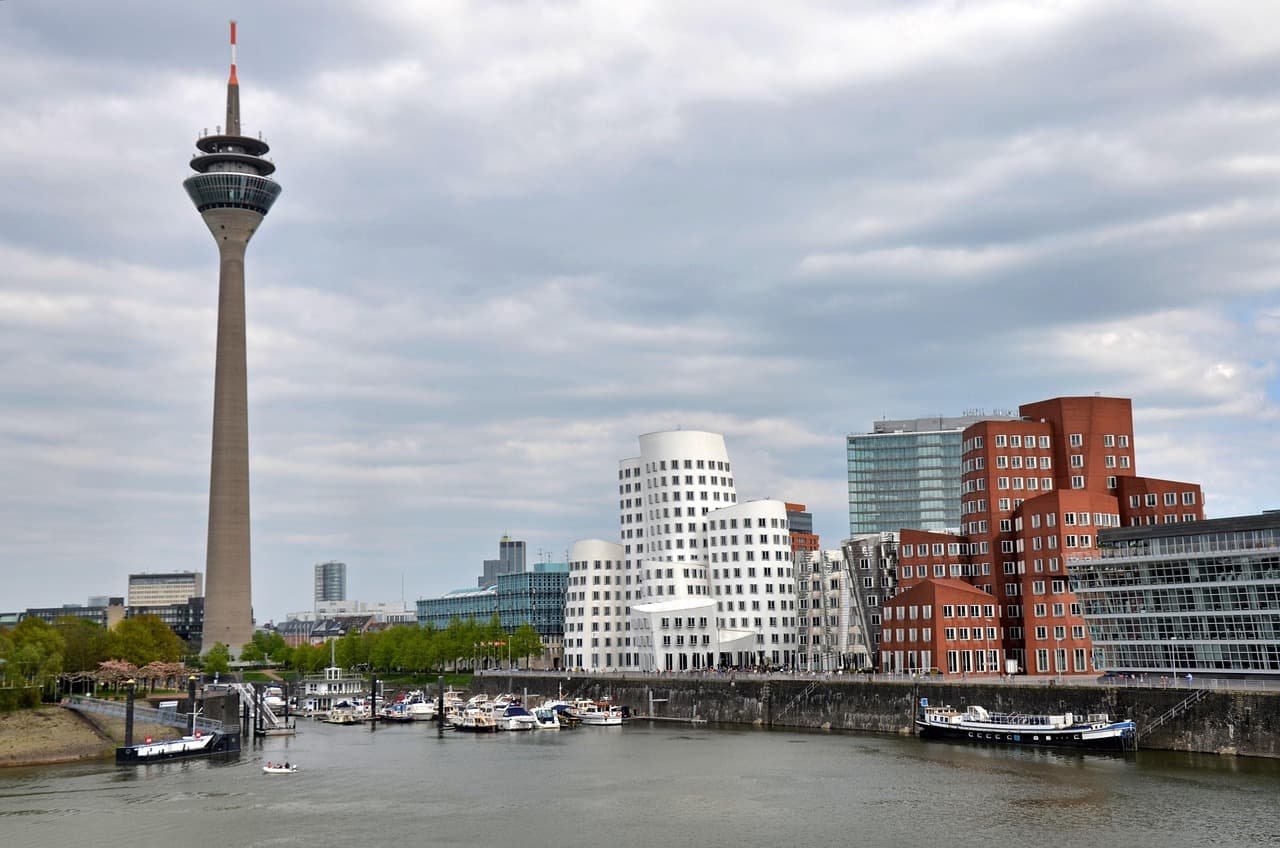
The Medienhafen — the old harbour redeveloped from the 1990s onward — is where the architecture became self-conscious. Frank Gehry's three buildings here are among his more successful experiments with deconstructivist facades: the irregular windows, the white rendering, the slight lean. They look better in person than in photographs, which is the correct direction for buildings.
The Japanese Quarter
Düsseldorf has the largest Japanese community in Germany and one of the largest in Europe — the result of Japanese companies establishing European headquarters here from the 1970s onward. The Immermannstraße and surrounding streets form Japan Town: Japanese supermarkets, noodle shops, ramen restaurants, sake bars, bookshops, travel agencies. It is entirely functional and not at all themed. The ramen at Takumi on the Immermannstraße is some of the best I've had outside Japan.
Düsseldorf