The White Mountain
Pamukkale's travertine terraces, Hierapolis above them, and why neither one prepares you for the other
The approach from Denizli city takes about half an hour. The landscape is flat and agricultural — cotton fields, vineyards, the low Anatolian plateau stretching in all directions. Then the white hill appears. From a distance it looks like a ski slope — a long, pale escarpment rising above the plain. As you get closer you understand that it is not snow and not rock but mineral deposit: calcium carbonate, precipitated from thermal springs over millennia, building a white terrace that descends in steps from the ridge above.
I had seen photographs of Pamukkale my entire life. I assumed I understood what it was. I did not.
The Terraces
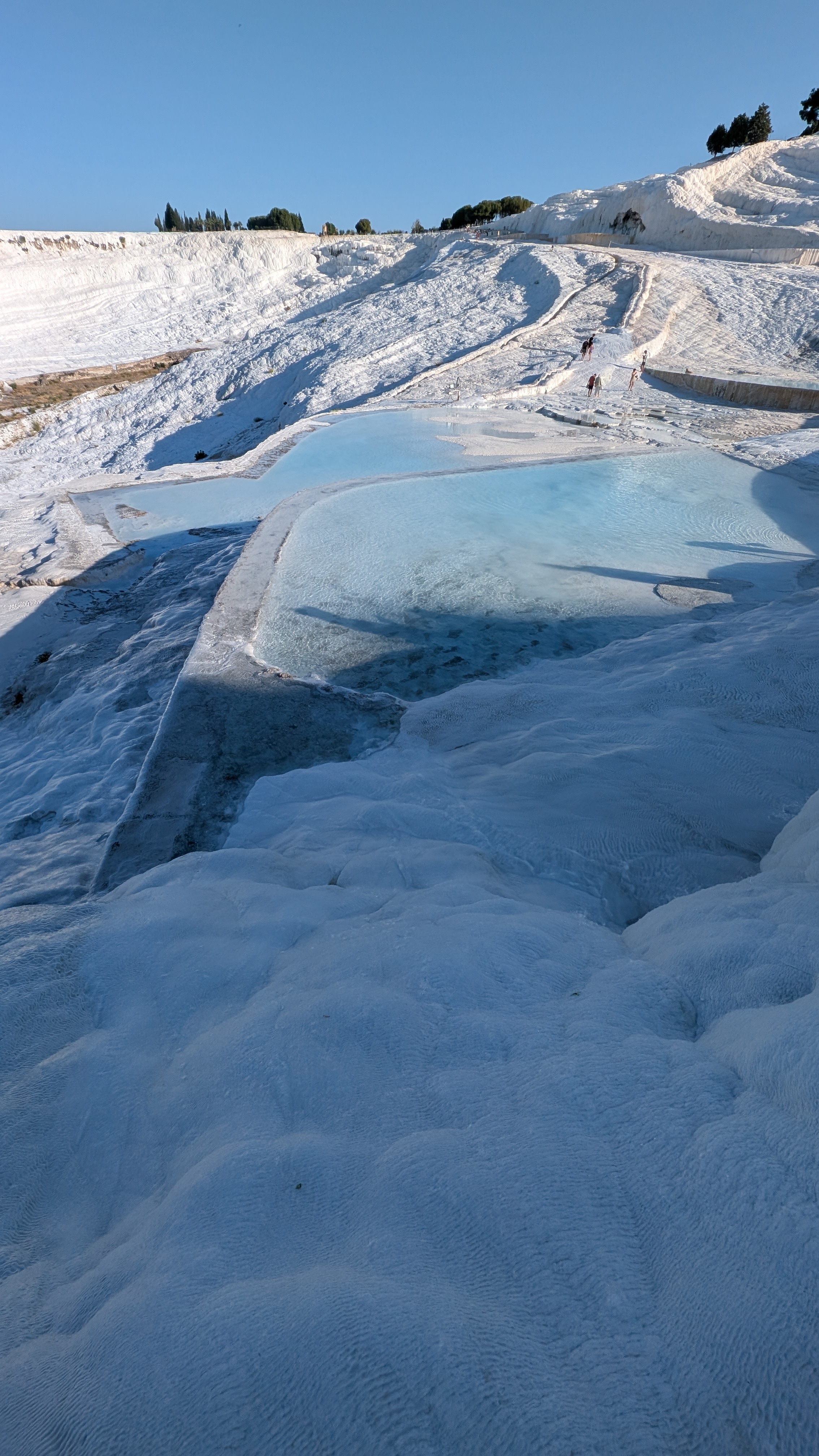
You enter the terraces barefoot. Shoes are not permitted — the calcium surface is fragile, and even bare feet do damage over time. The water in the active pools is warm, around 35 degrees Celsius, and the calcium-rich mineral content gives it a slightly slippery quality, like very soft water. The colour is the thing: in direct sunlight, the pools go the particular shade of turquoise that you only otherwise see in glacial lakes. Against the white calcium, framed by a blue Aegean sky, it looks digitally enhanced. It isn't.
The terraces are larger than photographs suggest. You walk for fifteen minutes from the lower entrance and you're still in them, the white expanse extending uphill in either direction, the individual formations — each one a shallow bowl with a curved white lip, filled with water — repeating in irregular patterns across the slope. Some pools are deep enough to sit in properly. The thermal water is comfortable. Some visitors stay for an hour.
Up Close
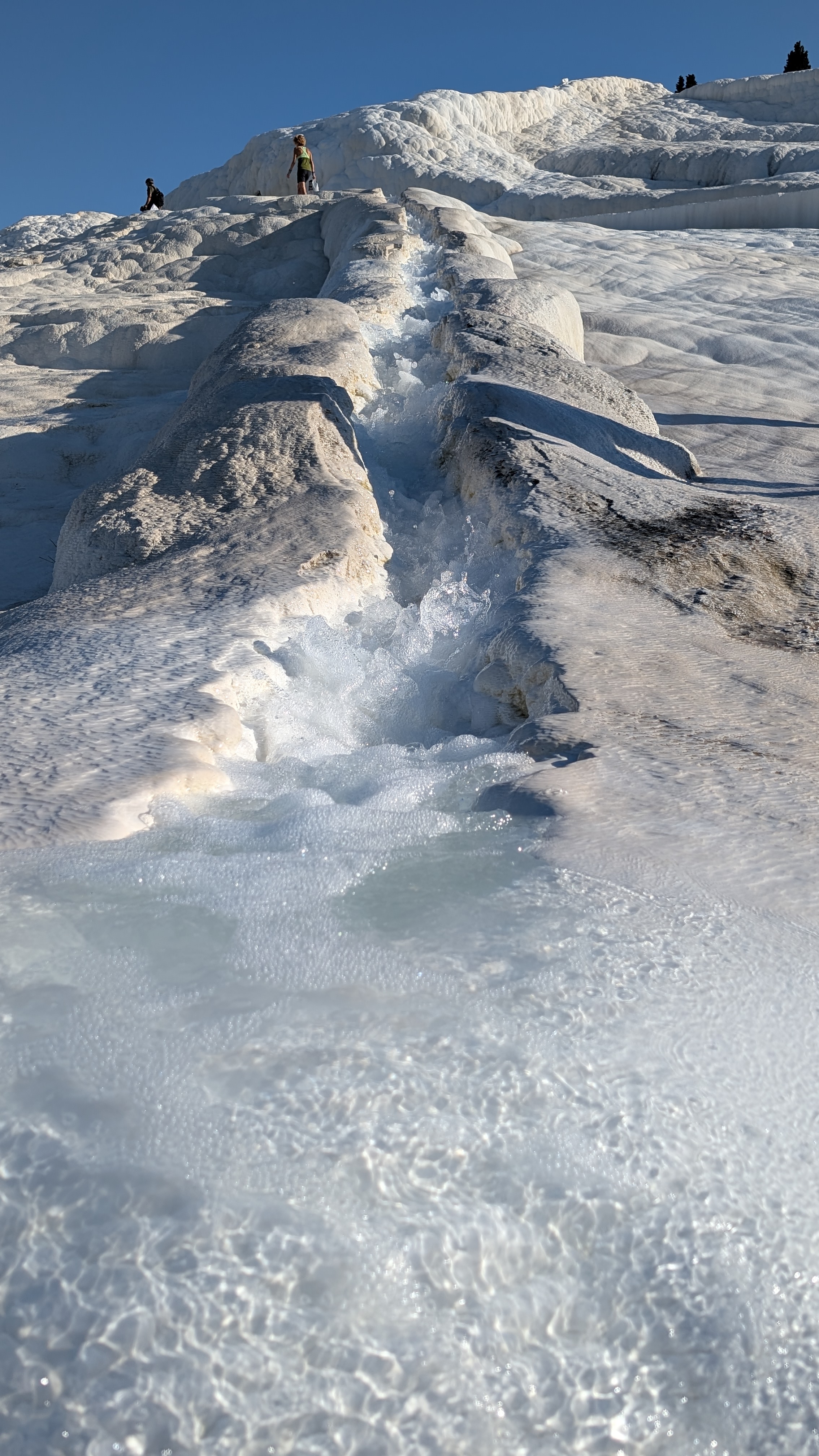
At ground level, the travertine formations are sculptural in a way the wide-angle photographs don't convey. Each lip of each pool has been built up layer by layer over centuries — a process that is still ongoing, the thermal water still flowing, still depositing calcium wherever it runs. The forms are organic and irregular: some look like frozen waterfalls, some like the ruffled edges of giant oyster shells, some like the ripples in a still pond suddenly stopped mid-motion.
The shadows in the formations are deep blue where the water collects and very white where the calcium is dry. The contrast is extreme. The whole surface is slightly warm underfoot from the geothermal water running through channels below. You are standing on something that is actively forming. This is not a ruin. It is a living geological process that happens to look extraordinary.
Hierapolis
At the top of the terraces, above the white calcium and the thermal pools, is an entire Roman city. Hierapolis was founded in the second century BC as a spa town — the thermal waters that created Pamukkale were already known and valued — and it grew into a substantial city that lasted through Byzantine times. What remains is extensive: colonnaded streets, a large theater, a necropolis that stretches for more than a kilometre outside the walls, baths, temples, a Christian basilica.
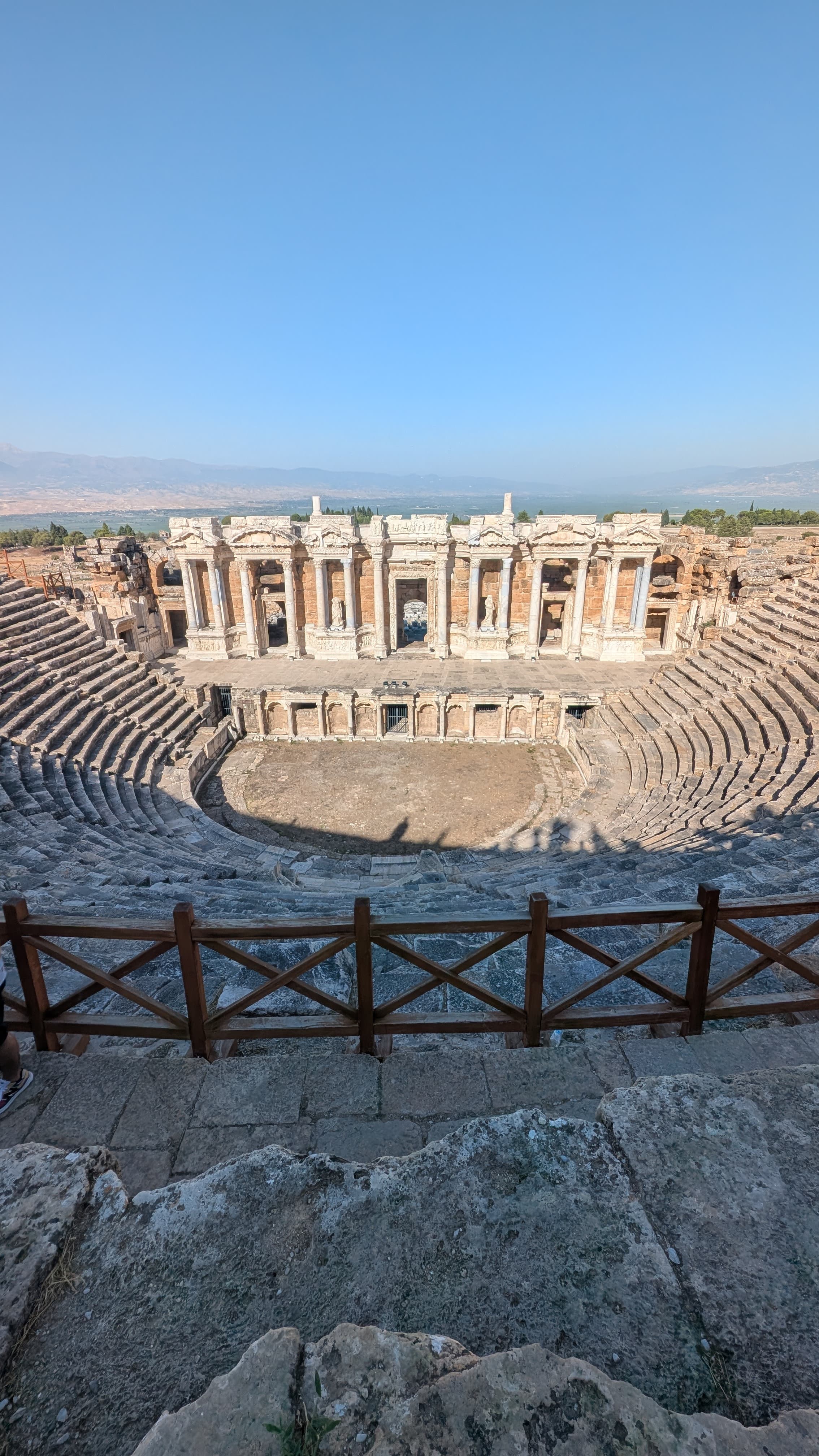
The theater at Hierapolis is in exceptional condition. The scaena — the ornate stone backdrop of the stage — is still standing to almost full height, its carved friezes largely intact. Frieze panels show scenes from mythology: Artemis hunting, Dionysus with his attendants, the labours of various heroes. The stone carving is detailed and confident, the work of craftsmen who knew their city would last. They were correct.
From the upper seats of the theater, you look out over the white escarpment of Pamukkale and the flat plain below, the cotton fields, the distant hills. The thermal springs that made Hierapolis wealthy are still flowing two thousand years later. The city that grew up around them is a ruin. The springs made something permanent anyway.
Practical Notes
Stay overnight in Pamukkale village rather than day-tripping from Denizli. The evening light on the terraces — after most visitors have left — is the session worth planning for. The thermal water in the hotel pools (many are genuinely fed by the same springs) is available all night. In the morning you can be at the lower entrance at seven and have the terraces largely to yourself before nine.
The necropolis at Hierapolis is worth an hour — the density of tomb types, the scale of it, the number of sarcophagi just lying in the grass — and most visitors skip it to get back to the pools. Don't.
Photography Notes
Morning light from below the terraces is the shot: the white calcium catching the low sun, the pools going luminous, the city of Hierapolis visible on the ridge above. The theater at Hierapolis is best at midday when the sun is high and the carved friezes are fully lit. Ground level on the travertine — lying flat to shoot across the surface of the pools — gives the image that explains the formations better than any wide shot.