Copenhagen: Cycling Through Noma Country
A city of bikes, Nordic restraint, and food that changed what restaurants think they're for
The first thing you notice is the bikes. Not a few bikes, not a dedicated cycling lane that drivers treat as a suggestion, but a full parallel transport system operating at the same scale as the car traffic. Cargo bikes carrying children and groceries and furniture. Commuters in suits. Old women in elegant coats. The bike lane is separated from the road by a kerb, runs the length of every major street, and has its own traffic signals. It simply works, and watching it work from a pedestrian perspective is oddly moving — a city that made a decision about how people should move through it and then built the infrastructure to match.
I hired a bike within two hours of arriving. The city becomes entirely different on two wheels. The distance between the old centre and Nørrebro and Vesterbro and Frederiksberg — neighbourhoods that feel separate on foot — collapses to fifteen minutes. You stop at canals. You cross the harbour bridge and the water is right there under you, clean enough to swim in (people do, in summer). Copenhagen is not a large city by the standards of a capital. On a bike, it feels even smaller, in the best possible way.
The Palaces and the Old Town
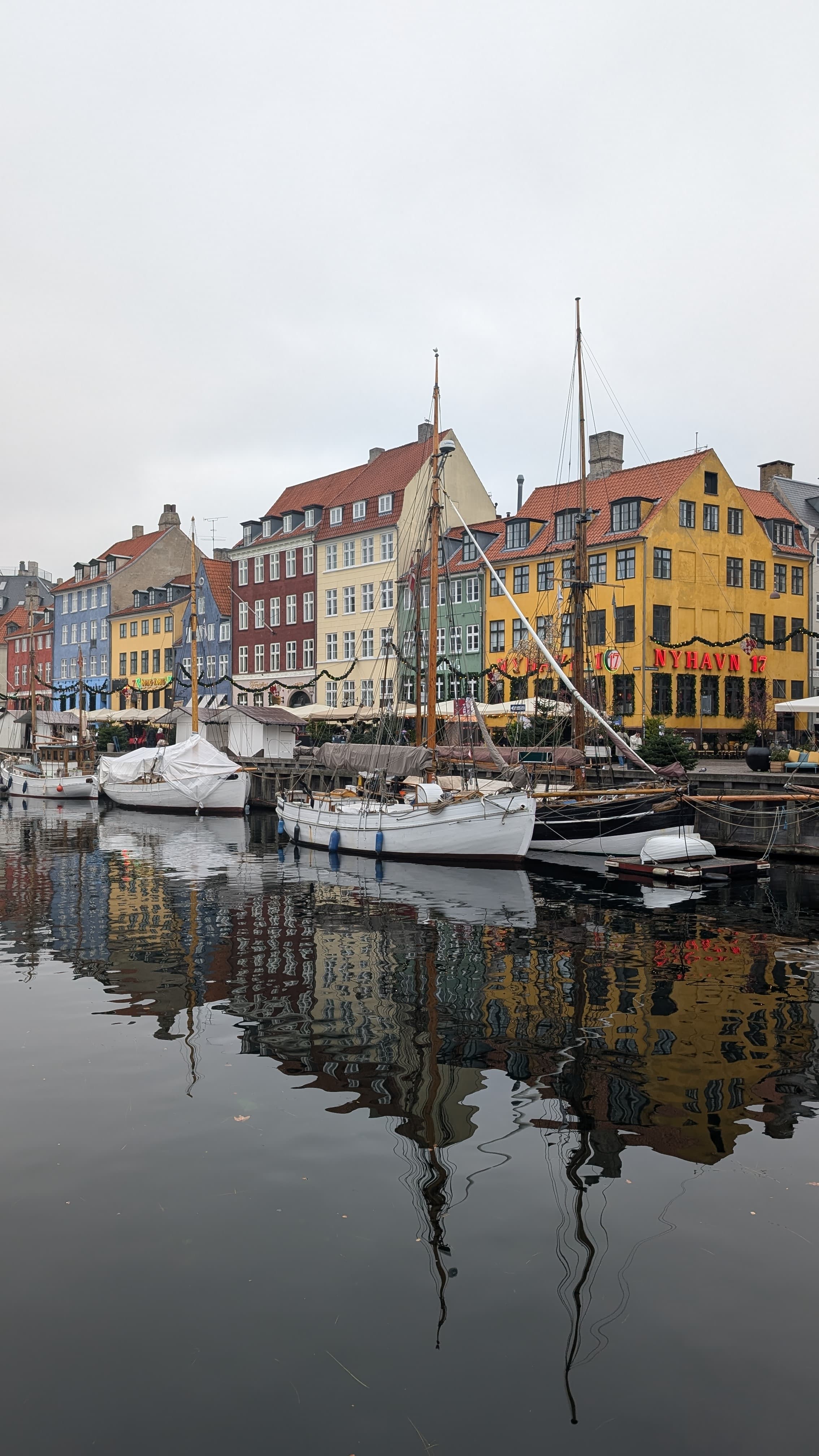
Nyhavn is the famous image of Copenhagen — the row of brightly coloured seventeenth-century merchant houses reflected in the canal, with old wooden boats moored in the foreground. It is a tourist magnet, and therefore easy to dismiss, and therefore worth visiting anyway because the thing that makes it famous is the thing that makes it genuinely beautiful. The colours are real. The boats are real. The reflection works. Go in the morning before the restaurants open their terraces and you will have it largely to yourself.
Amalienborg Palace — the royal residence — sits in an octagonal square surrounded by four identical Rococo palaces. The changing of the guard happens daily at noon and draws a crowd, but the square itself is worth visiting at any hour. It opens directly to the water and across the harbour you can see the Opera House — designed by Henning Larsen, funded by a single shipping magnate, and delivered in 2005. The relationship between the two buildings across the water is a piece of urban planning that either worked out well or was always going to.
The Food Scene
Noma changed what people thought Nordic food could be. Its influence on Copenhagen's restaurant culture is still felt, more than a decade after the original moment. You do not need to eat at Noma to taste its effects — the ethos of seasonal, foraged, fermented, local has filtered down into mid-range restaurants across the city, and the result is a food culture that is coherent and interesting even at lunch.
Smørrebrød — open-faced rye bread sandwiches — are the daily food. The rye is dense and slightly sour, the toppings elaborate: cured herring, pickled vegetables, egg and mayo, roast beef with remoulade. The best places serve them on paper-covered counters and you eat at a high table standing up. It's practical and surprisingly delicious and the bread is the best part.
Christiania and the Edges
Freetown Christiania — the self-governing community established in a disused military barracks in 1971 — is still there. It is not what it was in its early years and it is not quite what the myths say it is, but it is a genuinely interesting place: colourful self-built houses, workshops, music venues, a lake, vegetable gardens, and an atmosphere of organised chaos that feels like a functioning social experiment. Photography is not allowed in parts of it. Respect the signs and walk around. It takes about an hour and you will leave with something to think about.