Casablanca: Not the Film
Morocco's economic capital, the Hassan II Mosque, and a city that works too hard to be picturesque
Most people who visit Casablanca arrive at the airport and leave. The destination is usually Marrakech or Fès — somewhere with a medina, with colour, with the visual markers of Morocco that have been photographed and reprinted until they feel like a brand. Casablanca does not have those things in the same way. It has the Hassan II Mosque. It has the Corniche. It has wide Art Deco boulevards and a downtown that looks more like a French provincial city than any postcard version of Morocco. It works, and the working is what defines it.
I spent two days, intentionally, which most people said was too long. I don't think it was. You need the first day to calibrate — to understand what Casablanca is and stop looking for what it isn't — and the second day to actually see it.
The Hassan II Mosque
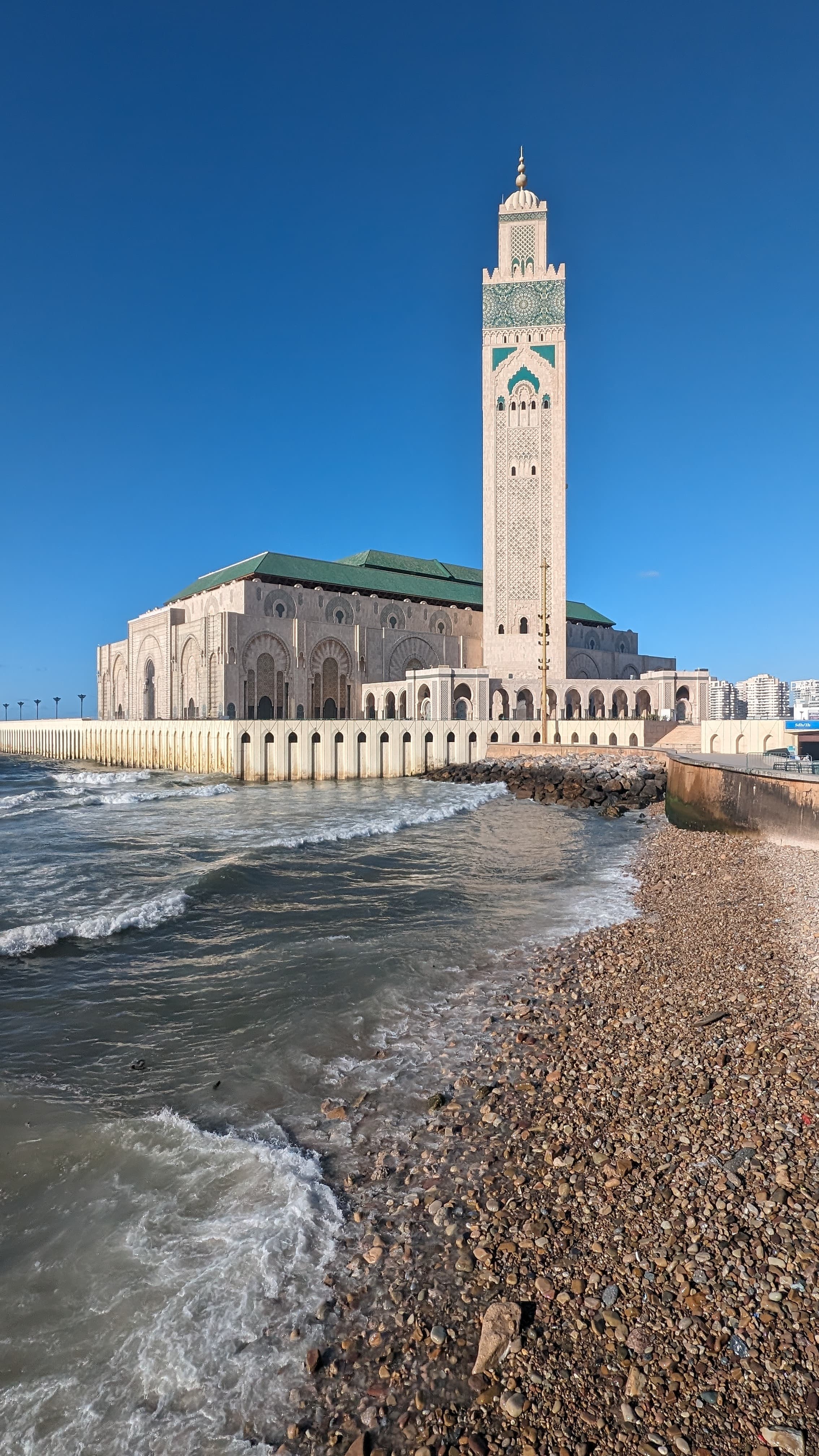
The Hassan II Mosque was completed in 1993 — the largest mosque in Africa, the second largest in the world — built on a promontory over the Atlantic. Part of its floor is glass, so worshippers can see the ocean below. The minaret is 210 metres tall. The laser on its tip points toward Mecca. It can hold 105,000 worshippers simultaneously, in the courtyard and interior combined.
Non-Muslims can visit on guided tours at set times, which is worth doing regardless of your relationship to the architecture. The interior is genuinely extraordinary: the craftsmanship on the carved plaster, the zellij tilework, the cedar woodwork ceiling — the level of detail is maintained at the same quality from the floor to the highest visible point. Moroccan artisans from all over the country worked for six years on the interior. You can spend an hour looking at surfaces and still find new things.
The location is the other thing. Standing outside the mosque in the late afternoon, with the Atlantic directly below and the spray visible on the rocks and the sky going pink over the water, is one of those moments where the scale of a thing and the scale of the landscape meet and the result is something that doesn't have a better word than sublime.
Art Deco Casablanca
In the 1920s and 1930s, French colonial architects built Casablanca as an experiment in modern urban planning. The result is a downtown — the Habous district adjacent to the new medina, and the central blocks around Place Mohammed V — with a coherent Art Deco character that is largely unrecognised outside the city. The buildings have the curved corners and decorative grilles and bold lettering of European Art Deco, adapted for the Moroccan climate with deep arcades and shaded courtyards.
Walk from the central market toward the ocean and the architecture accumulates. The post office building, the Palace of Justice, the apartment blocks on Boulevard Mohammed V — all the same era, all the same language, the city as a single architectural statement. Most of it needs restoration. Some of it is being restored. Walking it is an exercise in looking at a layer of history that is only now beginning to be taken seriously.
Food at the Port
The fishing port at Casablanca — the old port, not the commercial harbour — has a fish market and a row of restaurants where the fish goes directly from the market to the grill. The principle is simple: you walk through the market, choose what you want, the restaurant grills it and serves it with bread and chermoula (the Moroccan herb sauce) and a salad. The grilled sardines are the thing. Order more than you think you need.